
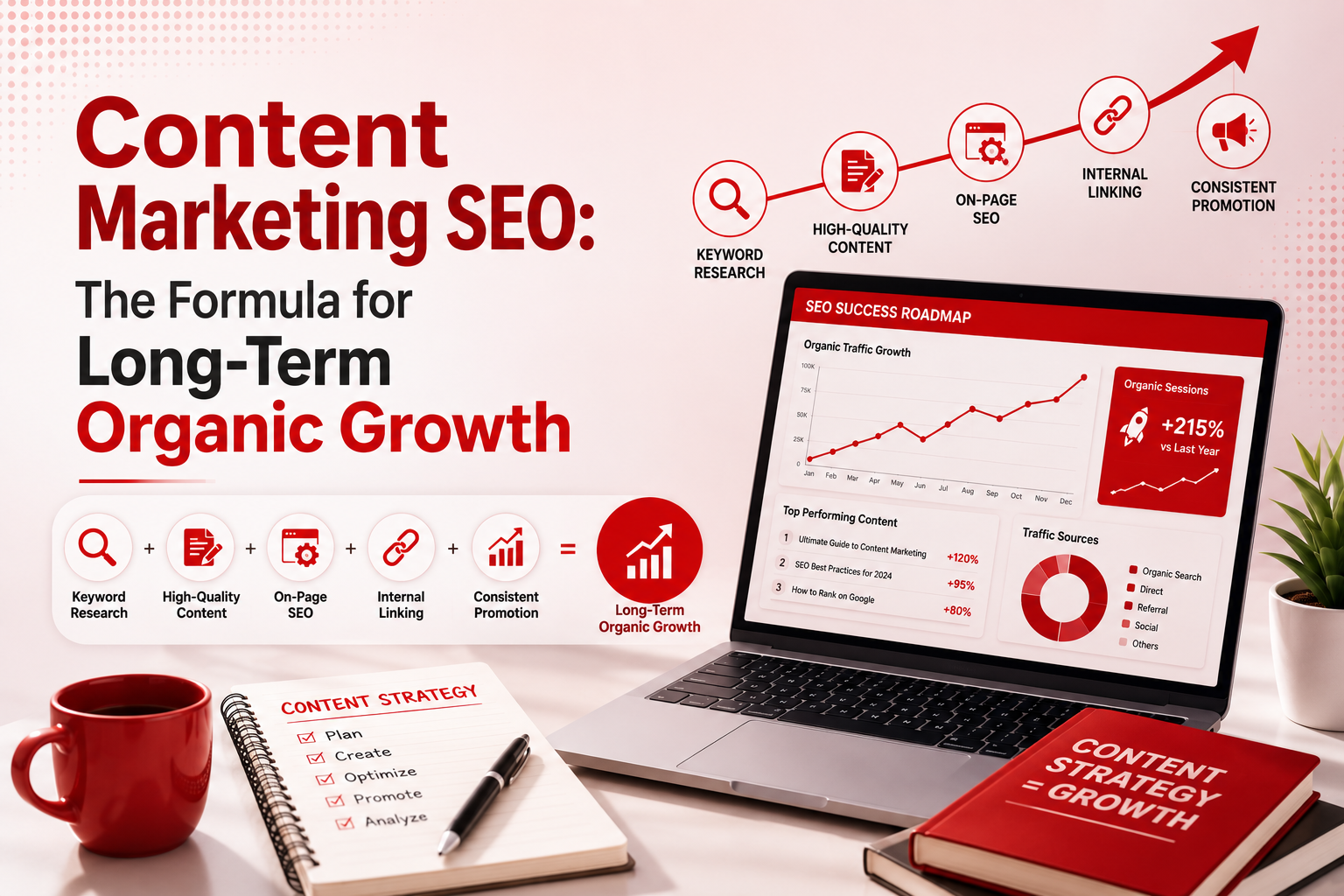
Walk into most companies and you’ll find content marketing and SEO treated as two completely separate line items. One team writes things. Another team optimizes things. And somewhere in that gap between the two, a decent chunk of potential growth just quietly slips away. Done properly, content marketing seo isn’t two disciplines bolted together after the fact — it’s really one system. Treating it that way is usually what separates steady, climbing organic growth from content that publishes fine but never actually compounds into anything.
This isn’t some minor distinction either. Businesses that connect the two properly tend to see traffic that keeps building month over month. Businesses running them as separate tracks often get an early burst from their first batch of posts, then plateau and can’t quite figure out why.
1. Why Content and SEO Were Never Actually Separate Jobs
Content marketing and seo work off the exact same underlying truth: people search for answers, and whatever answers those questions best, in the format Google happens to prefer, tends to win. Split the work into two separate teams and you often end up with content that’s beautifully written but poorly targeted — or well-targeted but thin, rushed, and not especially convincing once someone actually reads it.
Neither half on its own produces the kind of compounding growth that comes from doing both together, on purpose, right from the start.
2. What Content Marketing and Search Engine Optimization Actually Share
Content marketing and search engine optimization overlap a lot more than most org charts would suggest. Both require genuinely understanding the audience, not just guessing at what they want. Both depend on structure and clarity to actually work. And both, at the end of the day, are chasing the same outcome — getting the right content in front of the right person at the moment they’re searching for it.
Treat them as unrelated skill sets and you tend to create friction between teams that really should be sitting on the same content calendar, working from the same plan
3. Building a Real Seo and Content Strategy From the Ground Up
A genuine seo and content strategy starts with keyword and topic research first, then builds a content calendar around actual search demand — not around whatever feels important internally that month. This order matters more than it seems like it should. Publishing first and hoping SEO sorts itself out afterward almost never produces the same results as planning the two together from day one.
Flipping this order is often the single biggest lever available to a team that’s been publishing consistently and still isn’t seeing much traffic to show for it.
4. Why Content Seo Marketing Needs a Content Hub, Not Isolated Posts
Content seo marketing performs noticeably better when individual pieces link to each other around a shared topic cluster, rather than sitting around as scattered, disconnected posts with nothing tying them together. A well-built hub signals topical authority to search engines in a way that a pile of unrelated articles just can’t replicate, no matter how strong any single piece happens to be.
This kind of structural thinking takes more planning upfront, no question. But it tends to compound far more over six to twelve months than isolated posting ever manages to.
5. The Formula, Broken Down Into Actual Steps
Start with research — what’s your audience actually typing into the search bar, and what’s already ranking for those exact terms? Then plan — build content around real gaps you’ve found, not just whatever’s trending that week. Then write — with SEO structure baked into the first draft, not bolted on during a later editing pass. Then promote — because even genuinely great content needs a push through social and email to get any early traction at all. And finally, measure — tracking rankings and traffic every month, adjusting the plan based on what’s actually working rather than what you assumed would work.
Skip any single one of these five steps and the whole system tends to underperform, even when the other four are executed well.
6. Why Measurement Gets Skipped More Than It Should
Plenty of teams handle the research, planning, and writing well, then just stop paying attention once a piece goes live. That’s really where the compounding value quietly gets lost. Content marketing seo depends on iteration — noticing what’s actually ranking, doubling down on it, and reworking what isn’t, instead of treating hitting publish as the finish line.
Measurement doesn’t have to be complicated or fancy. It just has to actually happen, consistently, month after month, without getting skipped when things get busy.
7. How Long This Formula Takes to Show Real Results
Content marketing seo is a compounding strategy, not a quick win, and it’s worth setting that expectation early. The first few months often feel slow, with modest traffic gains that don’t yet reflect the structure quietly being built underneath. Somewhere around month four to six, well-executed strategies typically start showing a real, noticeable acceleration, as topical authority and backlinks start compounding together at the same time.
Businesses that give up on the strategy before that inflection point almost never get to see the payoff they were actually working toward.
8. A Quick Way to Check If Your Current Approach Has a Gap
Pull up your last five published pieces and ask, honestly, whether each one targeted a specific, researched search term — or was written first, with SEO considered afterward, if it was considered at all. If it’s mostly the second one, that gap is usually the fastest thing to fix before you publish anything else.
How Digital Growth Technology Approaches This
At Digital Growth Technology, content marketing seo never gets split across two disconnected teams. We plan, write, and optimize as one continuous process, so growth actually compounds instead of plateauing after an early burst of posts.
If your content and SEO efforts feel disconnected right now, get in touch with us and let’s build a system where they actually work together.