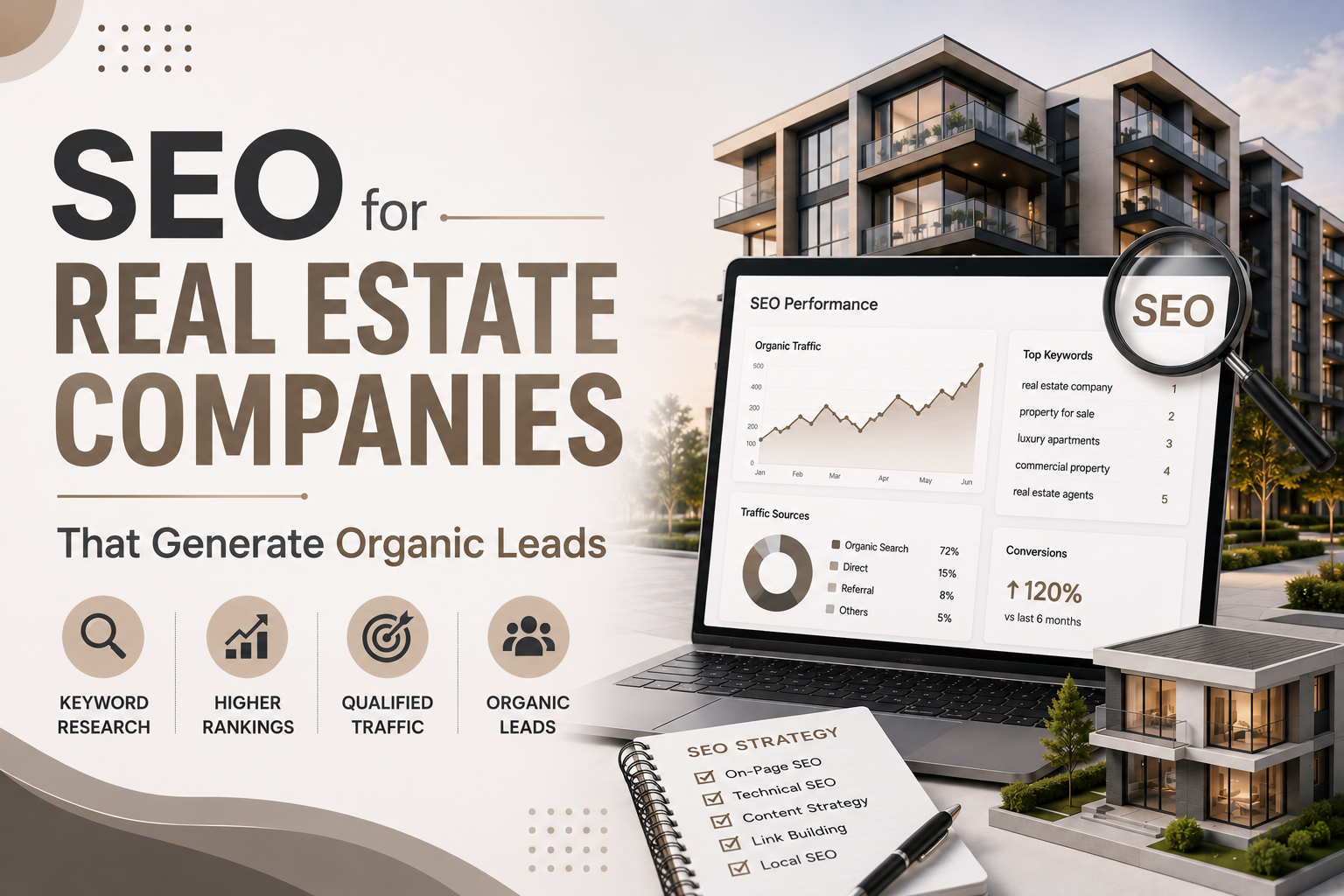
A lot of real estate companies rank for something — just not for anything that actually brings in a buyer. The homepage sits on page one for the company name. A blog post ranks for a term nobody searching for property would ever type. Meanwhile, the pages that actually need visibility — the ones with active listings and real inventory — sit buried on page three, quietly ignored. Done properly, seo for real estate companies isn’t about ranking for more things. It’s about ranking for the right things, the ones a real buyer types in right before they’re ready to call.
1. Why Generic Real Estate SEO Rarely Converts
Plenty of real estate SEO work focuses on broad, competitive terms — “flats for sale,” “property investment,” things with enormous search volume and even bigger competition. Ranking for these takes months, sometimes years, and even then, the traffic they bring is often too broad to convert well. Someone searching “property investment” could be anywhere in the world, looking at anything. That’s not the buyer a local project actually needs.
The stronger opportunity usually sits in narrower, more specific searches — location plus property type plus intent, like “3BHK for sale in [area]” — where competition is lower and the searcher is much further along in their decision.
2. Local Search Is Where Most of the Real Opportunity Lives
Real estate is fundamentally a local business, even for larger developers with multiple projects. A digital growth agency working in this space knows that a well-optimized Google Business Profile, consistent location details across directories, and location-specific landing pages tend to outperform broad national SEO efforts by a wide margin, simply because they match how people actually search when they’re serious about buying nearby.
This is unglamorous work — citations, map listings, location pages — but it compounds quietly over months in a way flashier tactics rarely do.
3. Why Listing Pages Need Their Own SEO Treatment
Listing and project pages often get built for sales, not search — heavy images, minimal text, no real structure for Google to understand what the page is actually about. That’s a missed opportunity. These are exactly the pages that should rank, since they’re the ones a buyer actually needs to find. Adding genuine, useful text around floor plans, pricing, amenities, and location context — without turning the page into a wall of copy — gives search engines something to actually index and rank.
4. Content That Supports the Buying Decision, Not Just Traffic
Blog content works best in real estate SEO when it answers questions buyers are actually asking mid-decision — home loan eligibility, documentation needed for a purchase, what RERA registration actually means for them. This kind of content builds trust and topical authority, and it often ranks for long-tail searches that pure listing pages never will.
The mistake most companies make here is publishing generic “top 5 reasons to buy a home” content that reads the same on every real estate site online. It technically exists. It rarely ranks, and it rarely converts even when it does.
5. Technical Basics That Quietly Decide Everything Else
Real estate sites are often image-heavy and slow as a result — large property photos, unoptimized galleries, sluggish mobile load times. Google’s own guidance on Core Web Vitals makes clear that page experience factors like load speed directly influence both rankings and how likely a visitor is to stick around. A beautifully photographed listing page that takes eight seconds to load on a phone is quietly losing buyers before they’ve even seen the property.
6. Building an Actual SEO Strategy Around The Seo for Real Estate Companies
None of these pieces work especially well alone. Local optimization without good listing pages sends visitors to weak content. Strong content without technical fixes ranks but loses visitors to slow load times. What actually generates organic leads is a connected digital growth strategy where local SEO, content, and technical health are all built together, not handled as separate, disconnected tasks.
8. A Quick Way to Audit Your Own Site
Search your own most valuable project or listing page’s target term in an incognito window. If your site isn’t on page one, or if it’s a generic page outranking your actual listing, that’s usually the clearest sign of where the SEO gap is in seo for real estate companies.
How Digital Growth Technology Approaches This
At Digital Growth Technology, seo for real estate companies is built around the searches that actually lead to inquiries, not just visibility for its own sake. We connect local optimization, listing page SEO, and technical fixes into one system built to bring in organic leads that convert.
If your site’s getting traffic but not real inquiries, reach out to us and let’s find out where the disconnect is.